
How to run a bar pool tournament
Everything a first-time organizer needs to run a clean 8-ball or 9-ball night: the decisions to make before the doors open, a checklist for tournament night, and the mistakes that turn a fun Wednesday into a two-hour argument.
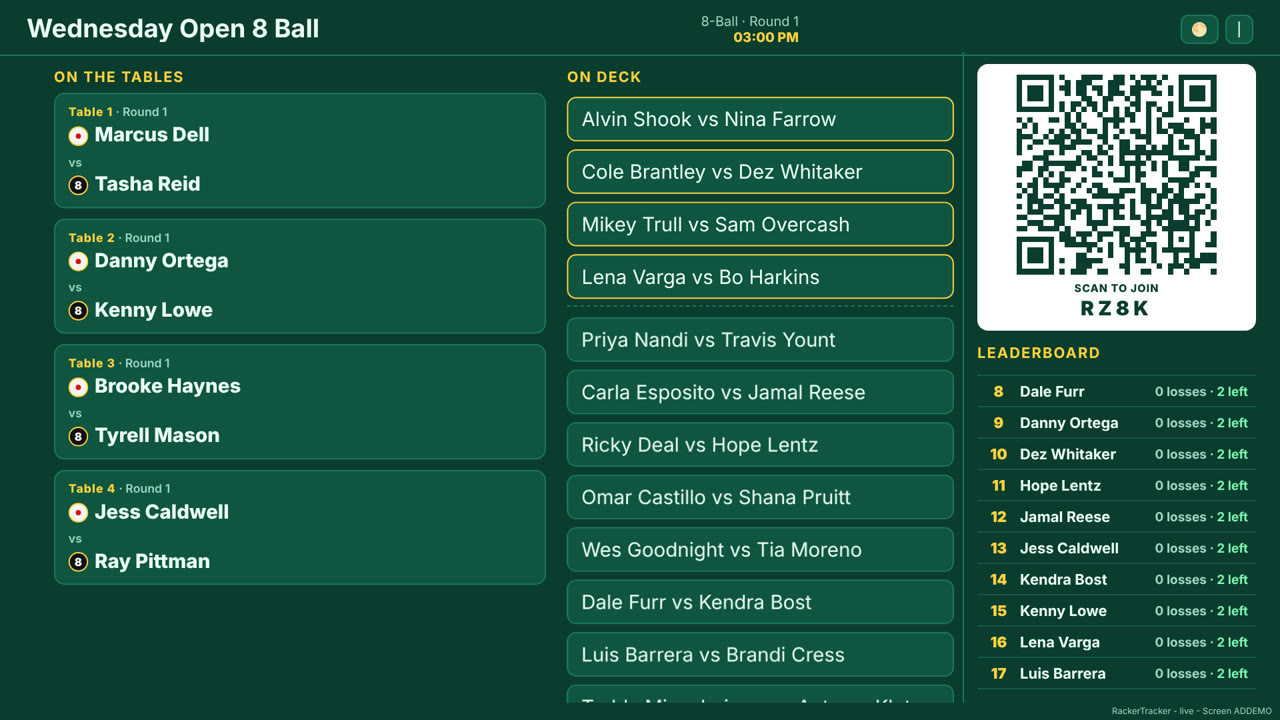
1. Decide what kind of night it is
Before anything else, answer one question: is this a weekly social or a money event? A weekly social wants a low entry ($5–$10), a format that keeps everyone playing, and a finish time the bar can live with. A money event wants a bigger entry, a stricter format, and seeding that keeps the strongest players apart. Most bar tournaments that die do so because they tried to be both.
Then settle the basics and write them where players can see them:
- Game: 8-ball is the bar default; 9-ball is faster and favours shot-makers. 10-ball if your crowd is serious.
- Race: race to 2 for a big field on a weeknight, race to 3 for 16 or fewer, longer only for finals. See formats for how race length changes the night.
- Rules: BCA/CSI, APA-style, or "bar rules" - pick one, name it, and put it on the sheet. Call-pocket or not, ball-in-hand on all fouls, how the 8 on the break is treated. The rule you leave vague is the one that gets argued at 11:40 pm.
- Handicaps: none (fastest, favours sharks), FargoRate races (fairest, needs ratings), or a house system. Our FargoRate guide covers the trade-offs.
2. Pick a format that fits the field and the clock
The format is the biggest lever you have over how long the night runs and how many games each player gets.
| Format | Best for | Games per player | Time (16 players, 4 tables, race to 2) |
|---|---|---|---|
| Single elimination | Big fields, late starts, one-table bars | 1 to 4 | About 1½ hours |
| Double elimination | Money events, serious players | 2 to 7 | About 3 hours |
| Multi-life (2 or 3 lives) | Weekly socials; everyone plays a lot | 3 to 8 | About 3 hours with 3 lives |
| Round robin | 8 players or fewer, leagues | Everyone plays everyone | Scales badly past 8 |
| Chip tournament | Casual rooms, walk-ins | As many as chips allow | Fixed by the chip count |
Rule of thumb: count your tables, estimate 12–15 minutes per race-to-2 match of 8-ball, and you can predict the finish time within half an hour. Four tables and 24 players in double elimination is a 4-hour night. If the bar closes at midnight and you start at 7:30, that is your answer.
3. Set the entry fee and the payouts in advance
Players care about two numbers: what it costs and what first place pays. Decide both before sign-up opens and never change them after the first match. The standard bar split is 50 / 30 / 20 for first, second and third; for fields over 24, pay four or five places (for example 40 / 25 / 15 / 10 / 10) so more people go home with something. If the bar adds money, say so loudly - "$100 added by the house" is the best advertising a tournament gets.
Decide the fee too: a flat green fee per player that goes to the house (or to the organizer for their time) is normal and should be stated separately from the pot. Use the payout calculator to settle the exact dollars before you announce anything.
4. Sign-up without the clipboard
A paper sheet works until someone writes "Mike" and there are three Mikes. Put a QR code on the wall and the bar TV, have players scan to join from their phone, and you get a clean roster with real names, no transcription, and a list you can seed from. Walk-ins who arrive after the start can still scan and be slotted in as a late entry if your format allows it. If the room is older or phones are scarce, the organizer can type names in; the point is that the roster lives in one place everyone can see.
5. Seed fairly, then draw the rest
For a weekly social, a random draw is fine and feels fair. For a money event, seed the top four to eight by FargoRate or last month's finishes so the two best players cannot meet in round one, and randomize everyone else. Announce the method; people accept any seeding they understood in advance and reject any they did not.
6. Keep the night moving
Dead tables are the silent killer of bar tournaments. The fixes are boring and they work:
- Call the next match the moment a table opens. Have the next pair on deck before the current one finishes. A live board that shows "On deck" does this for you.
- Let players report their own results. If every score has to go through you, you are the bottleneck. Have the loser report (or both players confirm) and move on.
- Put the bracket where everyone can see it. A bracket on the TV stops the "who am I playing?" parade to the organizer.
- Use a clock for stalls. A 30-second shot clock in the final rounds or a "two-minute warning to be at your table or forfeit" rule keeps the smokers honest.
- Decide the tie-break and bye rules before the draw. Byes go to the top seeds or a random pick - pick one.
7. The finish
Pay out in front of people, announce the top three by name, and say when the next one is. If you want the same crowd back, publish next week's date before this week's final rack is broken. A recurring weekly with a fixed time is worth more than any single big-money night.
Tournament-night checklist
- Format, race, rules and handicap decided and posted
- Entry fee, green fee, payouts and added money posted
- Sign-up open (QR on the wall and the TV) with a cutoff time
- Tables numbered, cues and chalk checked, lights on
- Bracket drawn and shown on the TV; byes announced
- Cash counted by two people and kept in one place
- Next date announced before the final
Run your next one with RackerTracker
Free for players. Organizers start with a free trial - no card needed.